
The $50 Million Mistake That Made Everyone Else Rich
One bad click on a phone. Fifty million dollars. And a feeding frenzy you never heard about.


Let’s start with what you probably already saw.
Yesterday afternoon, a DeFi whale named fxyo — self-described “chief liquidity provider” and “founder of nothing” — posted one of the most honest confessions in recent crypto memory:


Three-hundred-and-twenty-four AAVE. For fifty million dollars. At the time of the swap, that was worth roughly $37,000. He lost somewhere in the neighbourhood of $50.4 million in a single transaction. On a phone. After dismissing a warning.
238,000 people read that tweet. The ratio was merciless.
But here’s the thing most people missed entirely——the real story wasn’t the mistake. It was what happened in the two seconds after.
How Do You Lose $50M on a Swap
To understand this, you need to understand something called slippage.
When you go to a bank and wire $50 million somewhere, the bank moves $50 million. You get $50 million worth of whatever you’re buying. Simple.
Decentralized exchanges don’t work like that. They run on liquidity pools — buckets of two tokens that traders swap against. The price you get depends directly on how big the pool is relative to your trade. Dump $50 million into a shallow pool, and you drain it — buying up all the cheap tokens and pushing the price through the roof, against yourself, the whole way down.
The Aave interface warned fxyo. In fact, by Stani Kulechov’s (Aave’s founder) public account, the interface flagged “extraordinary slippage” and required a confirmation checkbox before proceeding. fxyo, trading on his phone, clicked through.
His $50.4 million in USDT was routed through CoW Protocol — a DEX aggregator meant to find the best price. But this order was so large that it couldn’t be efficiently filled anywhere. It hit an extremely shallow SushiSwap AAVE/WETH pool first, then cascaded into Uniswap V3. The price impact was catastrophic. He received 324 AAVE — about $114 per AAVE token when the market price was roughly $36,000.
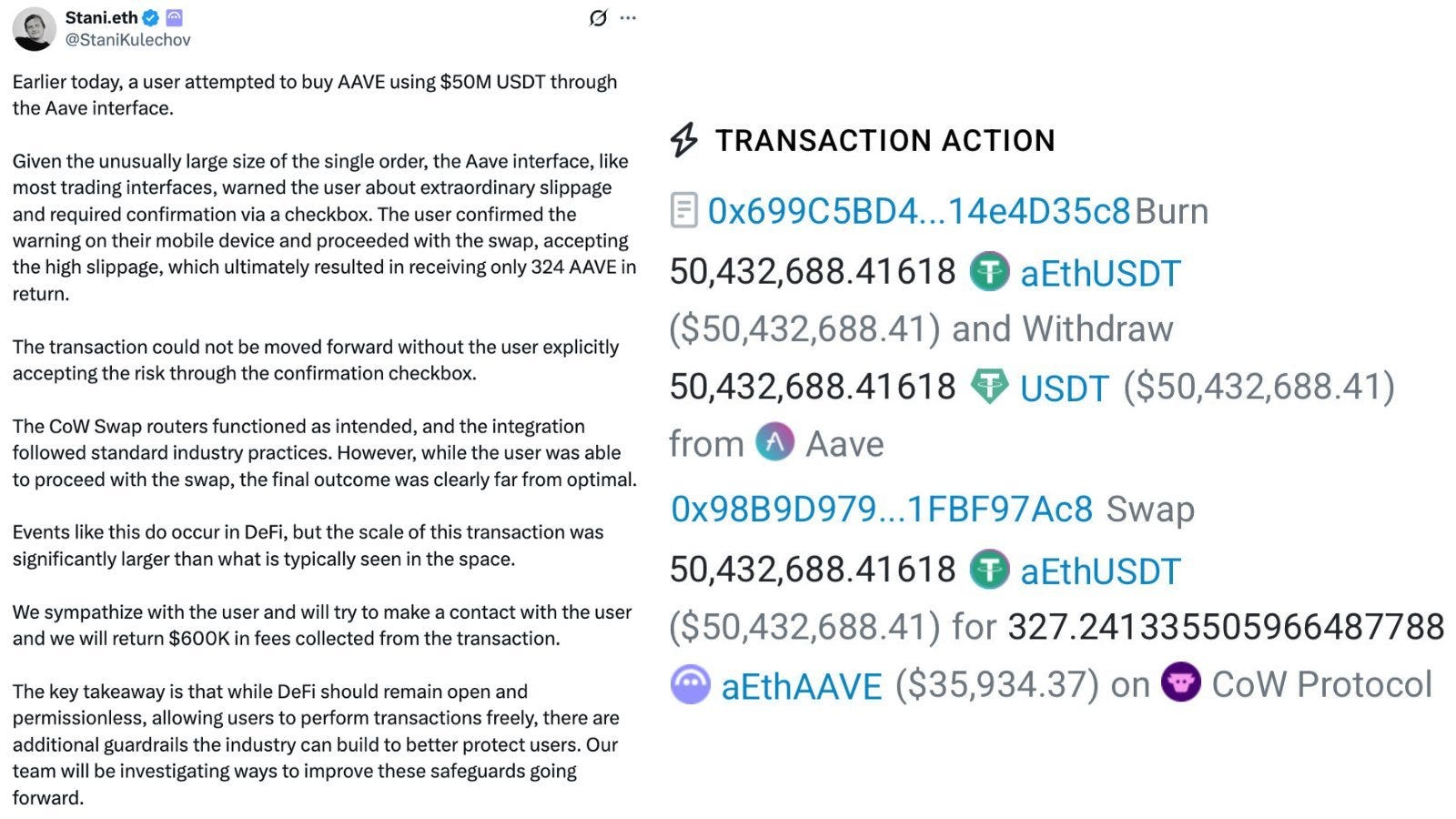
Wait. Let’s just sit with that for a second. $36,000 worth of coins. He paid over $155,555 per token for something that cost $114 at the time.
The Bots Were Already Watching
Here’s where it gets dark.
On Ethereum, every transaction sits in a public waiting room called the mempool before it gets added to a block. Sophisticated software — MEV bots — constantly monitors this waiting room, analyzing incoming transactions for profit opportunities.
fxyo’s $50M swap was not quiet. The moment it appeared, it was a dinner bell.
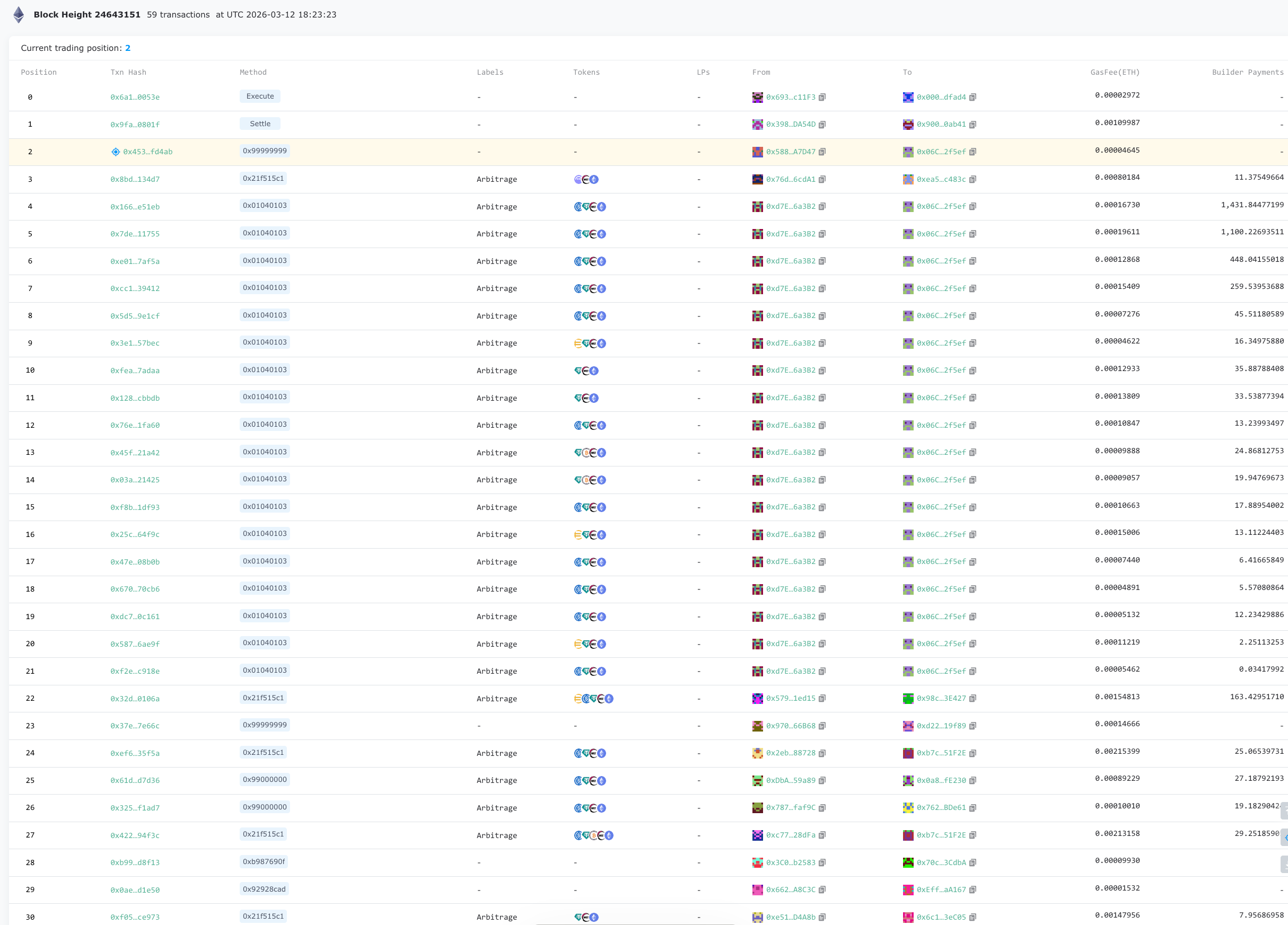
EigenPhi data shows exactly what happened inside Block #24643151, confirmed on March 12, 2026, at 18:23:23 UTC. That block contains 59 transactions. Position 1 is fxyo’s swap. Positions 2 through 27 are mostly marked Arbitrage.
A single MEV bot — contract address 0x06C...2f5ef — executed 18 arbitrage transactions in that same block, immediately after fxyo’s trade landed. The strategy was to backrun the trade and harvest the arbitrage it created.
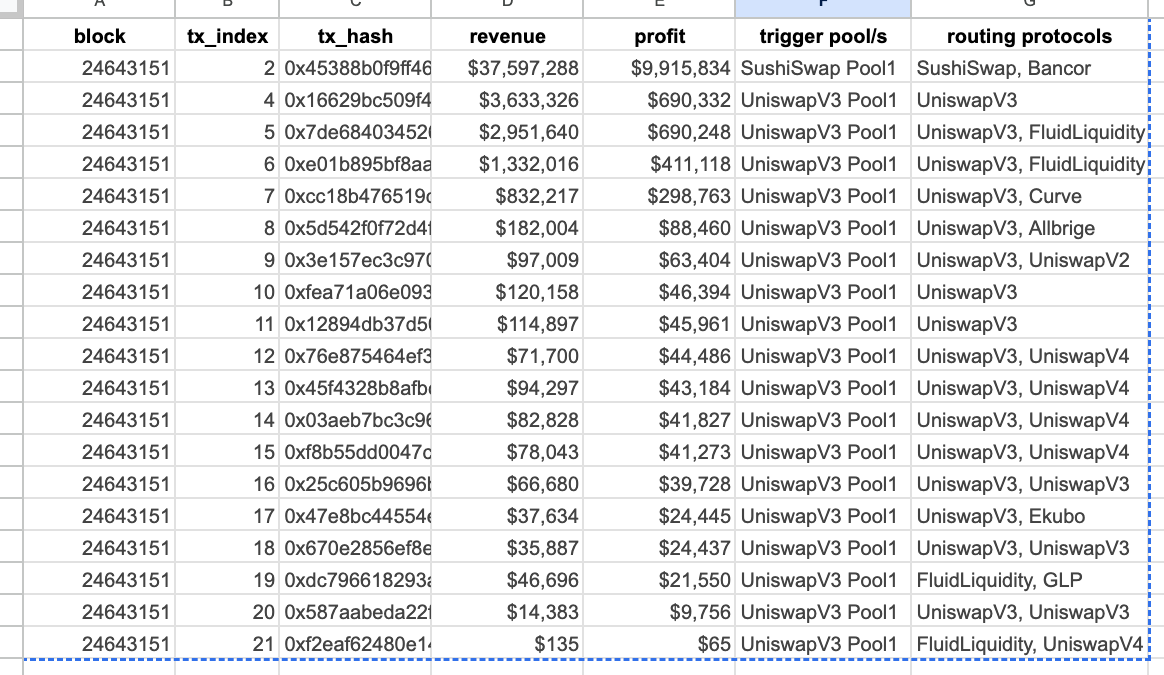
fxyo’s whale-sized swap had blown open massive price dislocations across AAVE/WETH and USDT/WETH markets simultaneously. The bot swept in and closed every gap, across SushiSwap, Uniswap V3, Bancor, Curve, Ekubo, FluidLiquidity, and more.
The top backrun transaction alone — viewable live on EigenTx — generated $37.5 million in revenue and $9.9 million in pure profit. In one transaction. In one block.
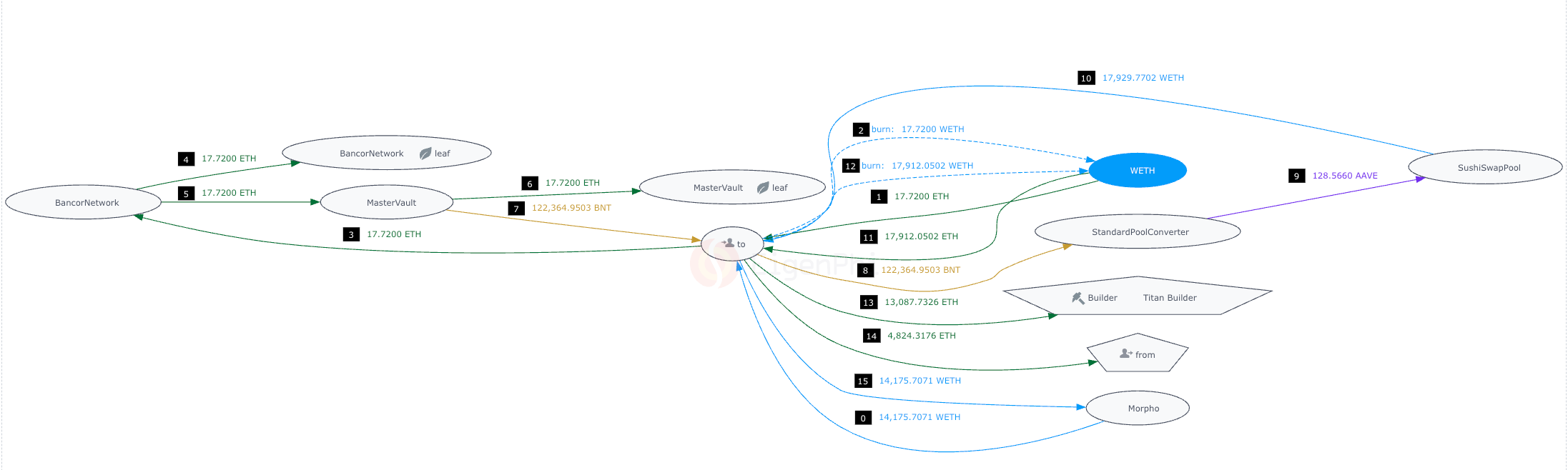
This tweet also shows how to connect the dots between transactions.


The Real Winner Wasn’t Even the Bot
This is the part of the story that almost nobody noticed.
EigenPhi flagged it first, 17 hours after the swap,

MEV bots don’t just execute arbitrage into thin air. To guarantee their backrun transactions land immediately after the victim trade — in the same block, in the right order — they have to pay. And they pay a lot. They bribe the block builder, the entity that assembles and proposes the block to the chain.
That block builder was Titan Builder.
From the token flow: Titan Builder’s address walked away with 13,087 ETH — approximately $28.6 million — as tips from this single block. The MEV bot’s own wallet pocketed 4,824 ETH, roughly $10 million.
Add it up:
Fifty million dollars went in. The victim got $37,000 worth of tokens. The builders and bots walked away with over $54 million in extracted value across the whole event. The $50M loss created downstream winners worth more than the original trade.
This Wasn’t a Hack. That’s the Point.
Stani Kulechov was careful to say the technology worked as designed. The Aave interface warned the user. CoW Swap’s routers followed standard practices. The transaction couldn’t be reversed without the user explicitly overriding the warning. He confirmed Aave would return the ~$800K in fees collected from the swap to fxyo as a gesture of goodwill.
But goodwill doesn’t cover $50 million.
What this event exposed is something the DeFi community has debated for years, and EigenPhi put it plainly: “The latest AAVE event is living proof of why we need better trade guardrails like EM” — a reference to Encrypted Mempools.
Right now, the moment your transaction hits Ethereum’s public mempool, it’s visible to every bot on the network. Encrypted mempools would hide transaction details until after they’re committed to a block, giving bots no time to react. Julian from Ethereum Foundation that encrypted mempools are “how Ethereum matures its onchain markets.”

The counterargument is equally valid: fxyo had $50 million. He was warned. He clicked through on his phone. At some point, permissionless finance means you are the last line of defence.
The Ledger
Let’s be precise about who made what from one human error on a Thursday afternoon:
fxyo: spent $50,432,688 USDT, received 324 AAVE (~$37,000). Net loss: ~$50.4 million.
MEV bot 0x06cf: 18 backrun arbitrage trades, $17.5 million pure profit from the event alone.
Titan Builder: $36.7 million in MEV tips for building the block.
Aave Protocol: ~$800K in fees (being returned to fxyo).
Crypto Twitter: priceless.
The block is immortal. You can see every transaction that happened in it, in order, forever, on a public ledger that no one controls and no one can change.
That’s the thing about DeFi. Nobody took fxyo’s money. He gave it away. And the infrastructure built to be maximally efficient at extracting value was waiting, as it always is, for exactly this moment.
Wonder if you have any misconceptions about MEV? Download our latest free e-book: MEV Myth Busters - From Microstructures to Macro Impacts.
Follow us via these to dig more into the hidden wisdom of DeFi:
EigenTx | Website | Discord | Twitter | YouTube | Substack | Medium | Telegram
your The Ledger section is missing a key data point: how much did the proposer earn from the builder?
$1.3M - determining the proportional fairness of these payouts is left as an exercise for the reader.
https://etherscan.io/tx/0xbe68ff01b96649867fed5650bdfa4a2ef34082d517c1be1086c2910672238bea