
5 Steps to Measure How Much Value Has Been Leaked From Your Order Flow
Don't leave these untapped profits on the table.


More and more wallets and dApps are becoming the entry point of order flows, which is good. But you may not know how much the untapped profit is in these order flows. Here are five steps to measure how much value has been leaked from your Order Flow.

Step 1: Identify all the channels generating order flows. For the convenience of your trader, you provide multiple ways for them to send out transactions: UI of wallet, APIs, or some aggregator using routers.

Step 2: Group your transaction dataset according to different channels.

Step 3: In each channel, find out the signal data of MEV.
❓ How many transactions are signals of MEV back-run arbitrages?
❓ How many transactions are signals, a.k.a. victims of sandwich MEV?

Step 4: In each channel, measure the values of these MEV signals:
❓ How much value has been generated by the signals of MEV back-run arbitrages?
❓ How much value has been generated by the signals, a.k.a. victims of sandwich MEV?

Step 5: In each channel's mempool dataset, time the difference between the signals and the related MEV txs. This would show you which channel is more valuable for searchers.
❓ How many milliseconds have been passed between the signals and the related MEV txs?

Next: Use your imagination. Join the dataset of different channels with different OFA providers. These data would help you make sense of which OFA provider is more effective than others in generating value.

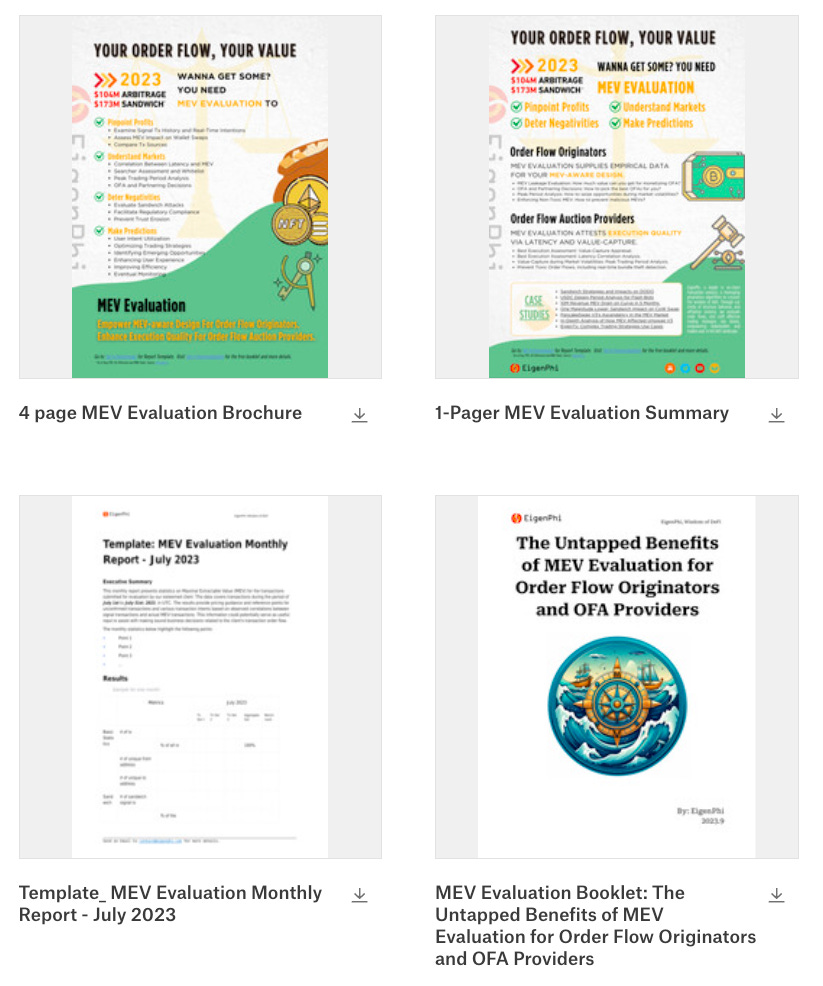
MEV Value quantification is key to implementing the above steps. To understand more about how to employ MEV Evaluation to get them done, please visit http://bit.ly/mevevaluation for infographics, report templates, and detailed booklets.
This video would be helpful for Order Flow Originators to calculate the value of your Order Flow.
Follow us via these to dig more hidden wisdom of DeFi:
Website | Discord | Twitter | YouTube | Substack | Medium | Telegram | EigenTx